Early methods
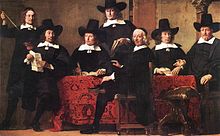
Merchants have sought methods to minimize risks since early times. Pictured,
Governors of the Wine Merchant's Guild by
Ferdinand Bol, c. 1680.
Methods for transferring or distributing risk were practiced by
Chinese and
Babylonian traders as long ago as the
3rd and
2nd millennia BC, respectively.
[1] Chinese merchants travelling treacherous river rapids would redistribute their wares across many vessels to limit the loss due to any single vessel's capsizing. The Babylonians developed a system which was recorded in the famous
Code of Hammurabi, c. 1750 BC, and practiced by early
Mediterranean sailing
merchants. If a merchant received a loan to fund his shipment, he would pay the lender an additional sum in exchange for the lender's guarantee to cancel the loan should the shipment be stolen, or lost at sea.
At some point in the 1st millennium BC, the inhabitants of
Rhodes created the '
general average'. This allowed groups of merchants to pay to insure their goods being shipped together. The collected premiums would be used to reimburse any merchant whose goods were jettisoned during transport, whether to storm or sinkage.
[2]
Separate insurance contracts (i.e., insurance policies not bundled with loans or other kinds of contracts) were invented in
Genoa in the 14th century, as were insurance pools backed by pledges of landed estates. The first known insurance contract dates from
Genoa in 1347, and in the next century maritime insurance developed widely and premiums were intuitively varied with risks.
[3] These new insurance contracts allowed insurance to be separated from investment, a separation of roles that first proved useful in
marine insurance.
Modern insurance
Property insurance as we know it today can be traced to the
Great Fire of London, which in 1666 devoured more than 13,000 houses. The devastating effects of the fire converted the development of insurance "from a matter of convenience into one of urgency, a change of opinion reflected in Sir
Christopher Wren's inclusion of a site for 'the Insurance Office' in his new plan for London in 1667".
[4] A number of attempted fire insurance schemes came to nothing, but in 1681,
economist Nicholas Barbon and eleven associates established the first fire insurance company, the "Insurance Office for Houses", at the back of the Royal Exchange to insure brick and frame homes. Initially, 5,000 homes were insured by his Insurance Office.
[5]
At the same time, the first insurance schemes for the
underwriting of
business ventures became available. By the end of the seventeenth century, London's growing importance as a center for trade was increasing demand for
marine insurance. In the late 1680s, Edward Lloyd opened
a coffee house, which became the meeting place for parties in the shipping industry wishing to insure cargoes and ships, and those willing to underwrite such ventures. These informal beginnings led to the establishment of the insurance market
Lloyd's of London and several related shipping and insurance businesses.
[6]
It was the world's first
mutual insurer and it pioneered age based premiums based on
mortality rate laying "the framework for scientific insurance practice and development" and "the basis of modern life assurance upon which all life assurance schemes were subsequently based".
[9]
In the late 19th century, "accident insurance" began to become available.
[10] The first company to offer accident insurance was the Railway Passengers Assurance Company, formed in 1848 in England to insure against the rising number of fatalities on the nascent
railway system.
By the late 19th century, governments began to initiate national insurance programs against sickness and old age.
Germany built on a tradition of welfare programs in Prussia and Saxony that began as early as in the 1840s. In the 1880s Chancellor
Otto von Bismarck introduced old age pensions, accident insurance and medical care that formed the basis for Germany's
welfare state.
[11][12] In Britain more extensive legislation was introduced by the
Liberalgovernment in the
1911 National Insurance Act. This gave the British working classes the first contributory system of insurance against illness and unemployment.
[13] This system was greatly expanded after the
Second World War under the influence of the
Beveridge Report, to form the first modern
welfare state.
[11][14]


